Let me start with a simple question.
When people talk about the Seven Sages of Destruction, what do we usually ask?
Who is the strongest?
Or who would win in a straight fight?
But in Frieren: Beyond Journey’s End, power is rarely about raw numbers. It is about compatibility. It is about blind spots. It is about whether your magic strikes the enemy’s weakness—or collides with their strongest defense.
So this is not a conventional power ranking. It is an explanation of why the Seven Sages cannot be compared through a simple strongest-to-weakest list.
Spoiler warning: This analysis discusses major abilities and events involving Böse, Aura, Grausam and Macht, together with speculative profiles for the three unidentified Sages.
Canon and theory are separated throughout the article: Böse, Aura, Grausam and Macht are established members of the Seven Sages. Kluft, Trieb and Pest are hypothetical models created to explain what the missing positions in the proposed counter system might require.

1. Who Are the Seven Sages of Destruction?
Within the power hierarchy of the Demon King’s army, the Seven Sages of Destruction represent the absolute peak of magic and devastation—a group so terrifying that humanity gave them a single collective name.
These seven are considered the Demon King’s strongest direct subordinates, ranking above every other Great Demon except Schlacht the Omniscient, the Demon King’s right-hand man.
Each Sage was granted control over vast territories, usually in strategically critical regions of the Northern Plateau. They ruled like warlords, building their own fortresses, armies and personal domains.
This was not merely political authority. Each individual Sage possessed enough magical power to wipe out an entire nation or reshape the landscape of a region.
Yet despite being called the Seven, they never functioned as a close-knit team.
Demons are fundamentally individualistic. The human concept of cooperation was never their natural strength, which is why the Seven Sages gathered as a complete group only in extremely rare situations.
2. The Seven Sages Were Designed to Complement—and Counter—Each Other
From what the story shows us, the Seven Sages do not feel like seven random overpowered demons placed under the same banner.
They can be read as a closed system: one deliberately designed by the Demon King to counterbalance itself, preventing any single Sage from becoming an uncontrollable and absolute threat.
Think of it as demonkind’s version of checks and balances. It is not democratic, but it is extremely effective.
At the same time, this arrangement creates a military force capable of responding to almost any tactical situation, no matter how extreme.
At present, four of the Seven Sages are clearly known:
- Böse the Immortal
- Aura the Guillotine
- Grausam the Miraculous
- Macht of El Dorado
The other three were defeated by the Hero of the South, but their identities and abilities have not been revealed.
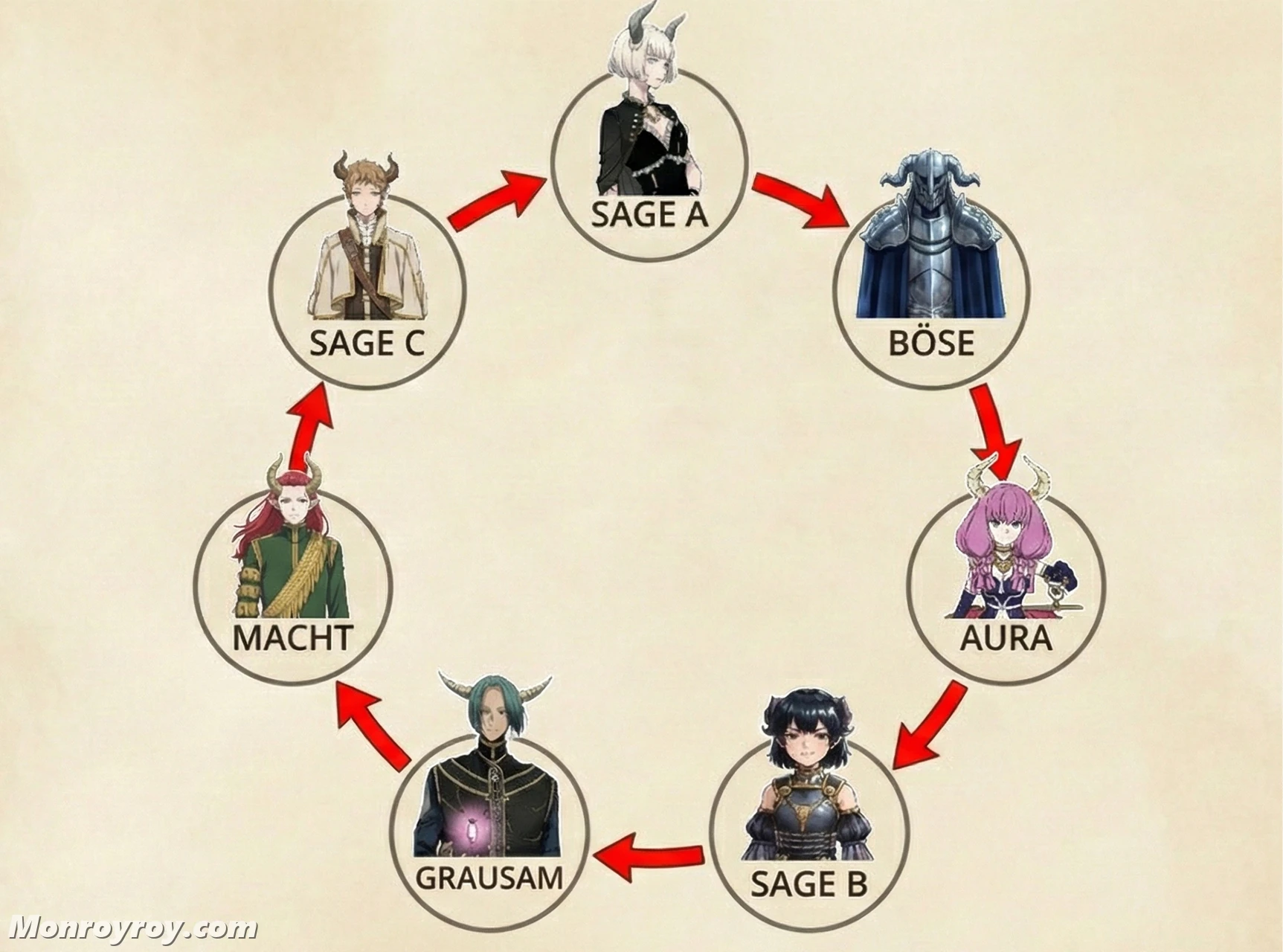
The following model is therefore hypothetical. It proposes how the Seven Sages may have countered one another through magical mechanics rather than simple differences in mana or destructive output.
Each arrow represents decisive counterplay—not a small advantage, but a tactical relationship in which one ability directly attacks the assumptions behind another.
3. The Abilities of the Four Known Seven Sages
Before the three missing Sages can be imagined, the four established members must be examined carefully.
The crucial questions are not only what they can do, but how they win—and, more importantly, how they can lose.
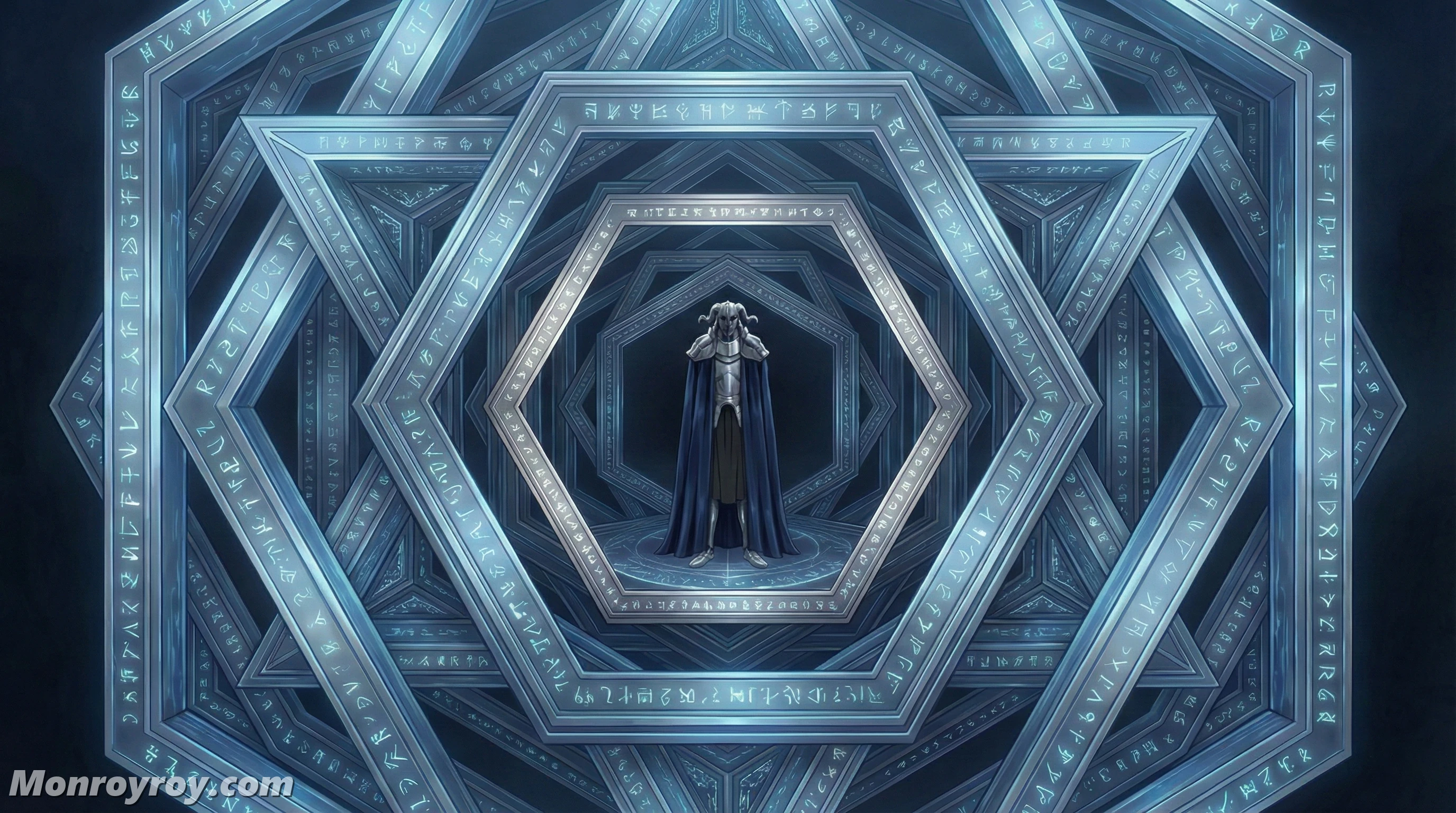
Böse the Immortal
Böse is a Great Demon famous for one quality above all others: absolute defense.
Despite the title “the Immortal,” his reputation does not come from regeneration or healing. It comes from a single belief:
Nothing can touch me.
In Frieren’s world, that belief is everything.
Signature magic: Unbreakable Barrier Magic
Böse creates massive, multilayered barrier structures—geometric enclosed spaces that completely isolate whatever is inside from the outside world.
Once trapped, an opponent has only two options: be crushed or suffocated inside the barrier, or continue attacking until all strength is exhausted.
In the past, the barrier was believed to be completely unbreakable, immune to every known human spell and physical attack. Even Frieren struggled against it during the Hero Party’s encounter with Böse.
It was only broken through the combined effort of the party, especially after Himmel convinced everyone that Böse’s “unbreakable” barrier was not truly unbreakable.
Why Böse Counters Aura
Böse is an exceptionally bad matchup for Aura because his barrier can isolate him so completely that her control magic cannot reach him.
He can also trap Aura inside a perfectly sealed barrier. Once that happens, her magic cannot affect the outside world, escape becomes nearly impossible and she is left to exhaust herself inside.
Based on what the story shows, Aura does not possess many options beyond Auserlese and her enormous mana pool. She is not a highly versatile direct combatant, and demons do not excel at cooperative rescue strategies.
Once sealed away, there is no clever second plan waiting to save her. Böse becomes a hard stop for Aura.
Aura the Guillotine
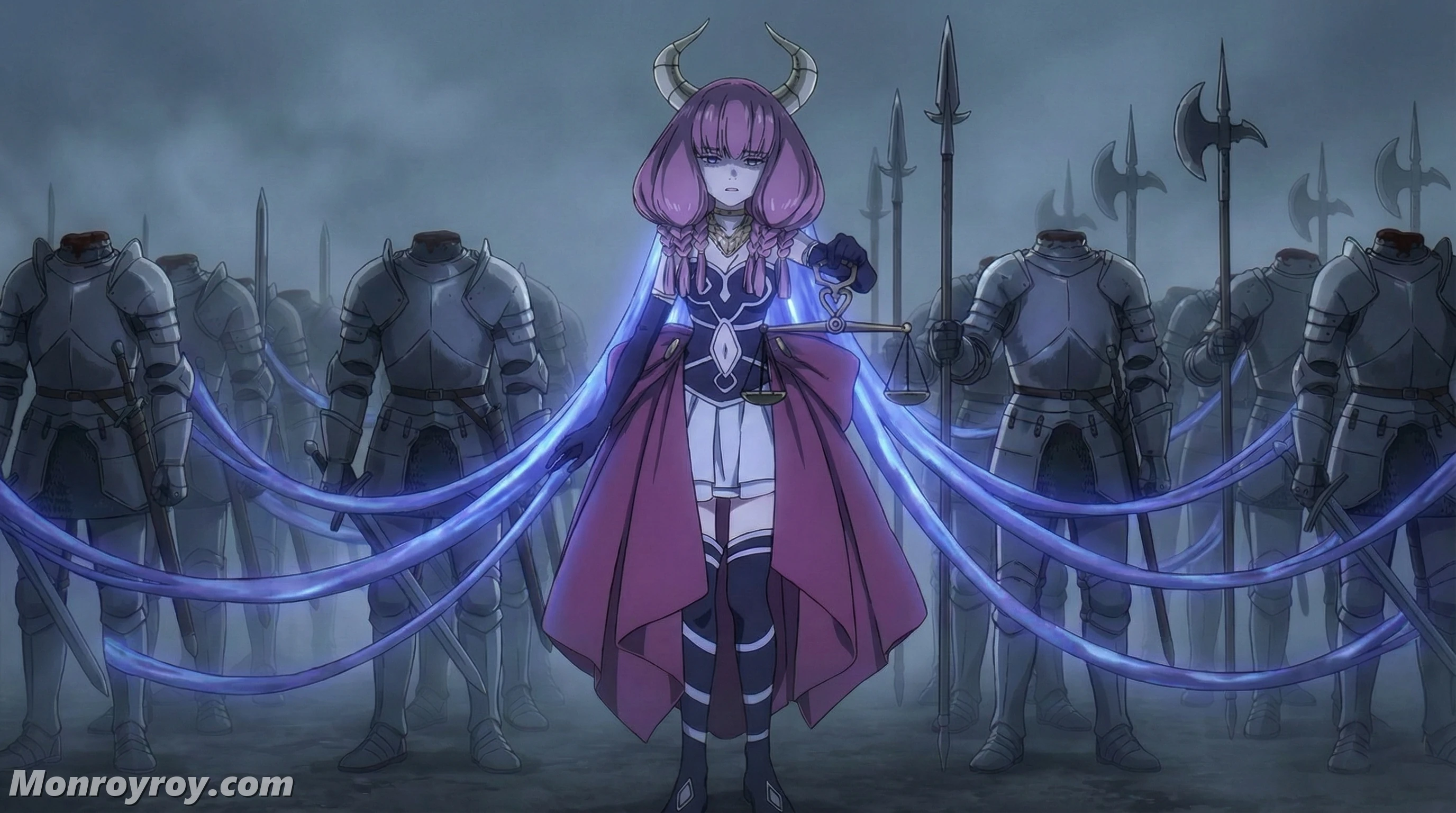
Aura is a Great Demon with an absurd amount of mana—more than five hundred years’ worth of accumulation.
She represents demonkind’s cold calculation and arrogance in its purest form.
Signature magic: Auserlese—Scales of Obedience
Auserlese summons a magical scale that compares Aura’s mana with her opponent’s. When Aura possesses more mana, the target becomes her permanent puppet.
There is no resistance and no second chance.
This is how Aura built her Immortal Army: the headless soldiers she controls in enormous numbers. Through them, she can overwhelm opponents without placing herself directly on the battlefield.
Her preferred method is attrition warfare. She grinds enemies down with puppets, waits until their mana drops far enough and then ends the battle with the scales.
The Limits of Auserlese
Auserlese is powerful, but it is not flawless.
First, opponents with overwhelming mana reserves can resist the entire strategy. When Aura’s army cannot drain their mana quickly enough, her plan collapses.
Second, the spell appears less reliable against targets that are hidden, lack a conventional soul or mana structure, or are not living beings at all—such as machines and objects.
There is also a larger question. If most humans possess less mana than Aura, why did it take her so long to build a large army before facing Frieren again after Himmel’s death?
This strongly suggests that maintaining the Immortal Army consumes an enormous amount of mana, or that Auserlese has meaningful limitations against defenses such as impenetrable barriers and individuals with exceptional resistance to curses.
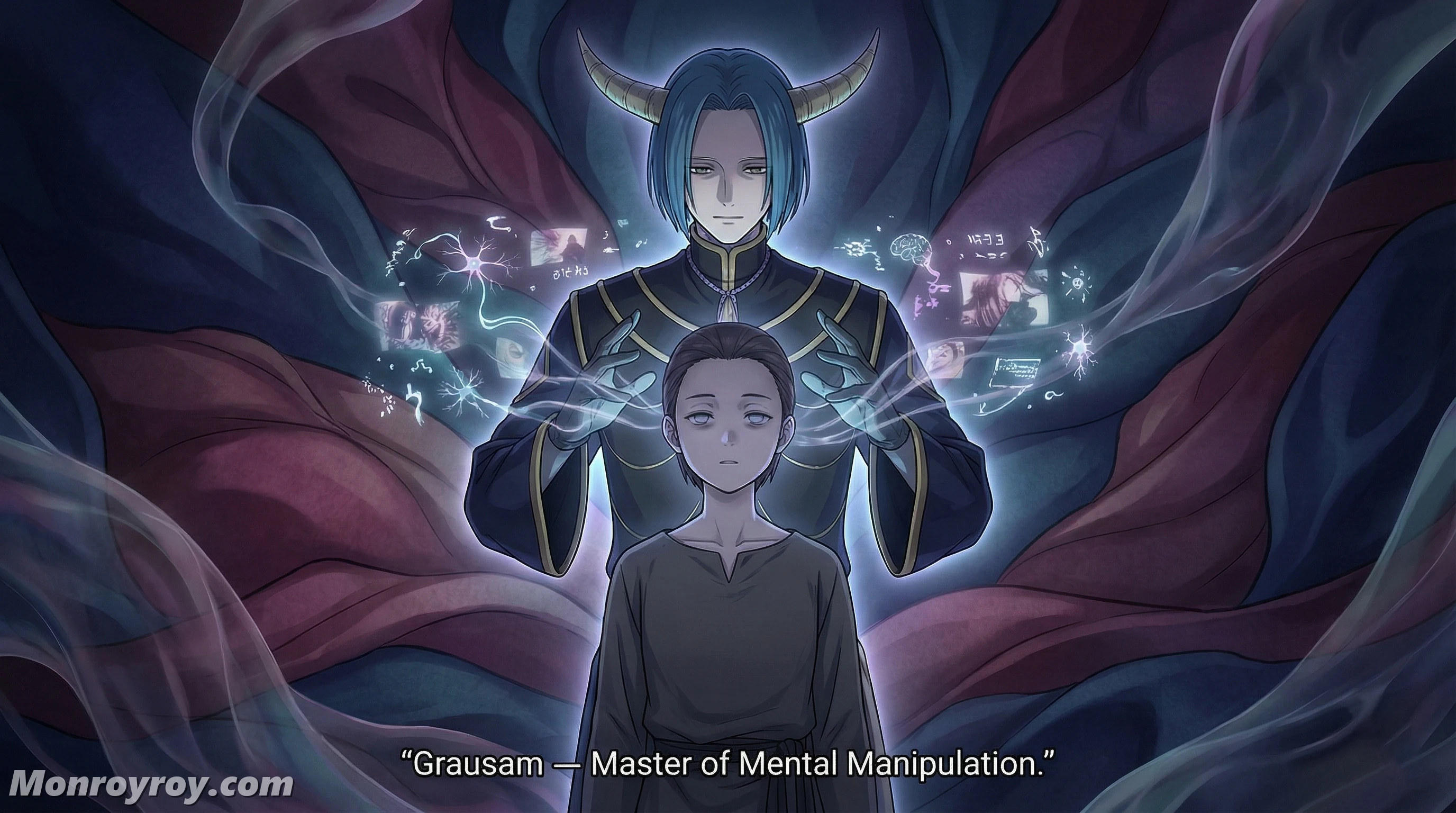
Grausam the Miraculous
Grausam is one of the most dangerous and unsettling entities in the entire series.
He specializes in mental manipulation, and he is notably the only Sage whom Macht openly acknowledges as a bad matchup.
That alone reveals how threatening his magic is.
Signature magic: Mental Manipulation and Perfect Illusions
Grausam can create illusions that cannot be distinguished through sight, sound or even mana detection.
He can completely hide his presence and mana, reaching the point where even Frieren could not sense him while he was standing beside her.
He can edit, erase or replace memories, including wiping Macht’s memory of his battle against the Hero of the South.
He can also trap opponents inside dreamlike illusions formed from their happiest memories and deepest desires. This is how he incapacitated the Hero Party until Himmel’s willpower broke through.
Grausam does not truly aim to win a battle. He aims to make sure the battle never happens.
His ideal victory means breaking an enemy’s will, turning allies against one another or pushing opponents toward self-destruction.
The Limits of Grausam’s Magic
Even Grausam has clear weaknesses.
His magic becomes far less effective against beings without complex minds, opponents who fight through pure instinct and allow the body to react before conscious thought, or high-ranking Priests protected by Goddess Magic, such as Heiter.
The reason he counters Macht becomes clear once Macht’s own limitation is examined: destructive power is meaningless when the target cannot be located or correctly perceived.
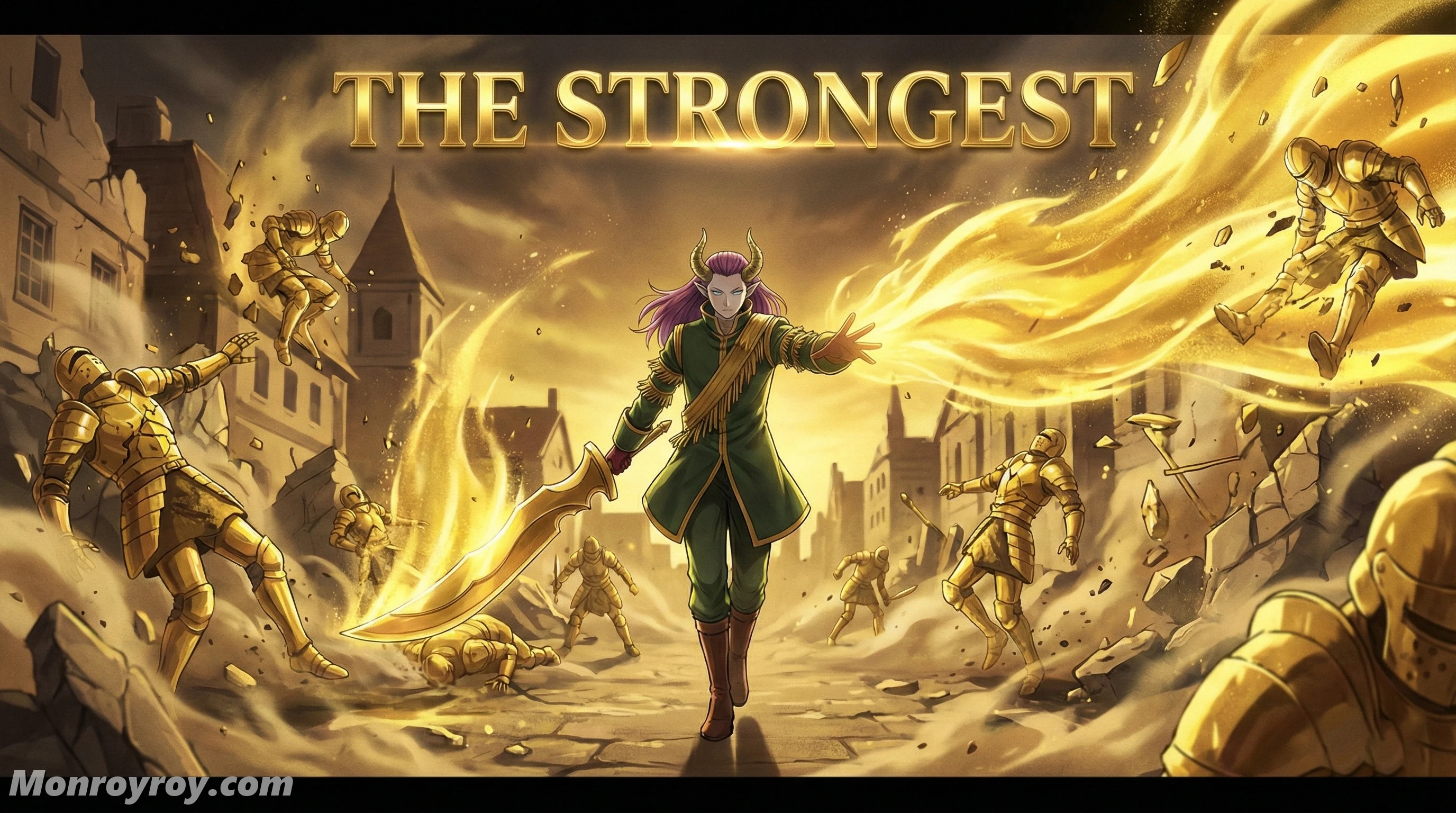
Macht of El Dorado
Macht is widely regarded as the most powerful member of the Demon King’s Seven Sages of Destruction.
But powerful does not mean he would defeat every other Sage in a direct confrontation.
He is also the only one who actively tried—and failed—to understand human emotions such as malice and guilt.
It was not a lack of effort. Demons simply are not built to understand those feelings in the same way humans do.
Signature magic: Di Agölze—Universal Gold Transmutation
Macht can transform almost anything into solid gold: living matter, physical objects and even magic itself.
The range is enormous. It can cover an entire city such as Weise, extend beyond the Great Barrier that imprisoned him and remain active even after Macht’s death.
Anything turned to gold cannot be destroyed, reshaped or restored through ordinary means.
The most terrifying part is that a target may not even realize when Macht has activated the spell. A person can become gold before understanding that an attack has begun.
The Limits of Di Agölze
Even this level of power is not absolute.
The first counter is Mistilziela, Serie’s curse-reflection spell, which can reflect magic perceived as a curse—including Di Agölze.
The second and more important limitation is perception. Macht must recognize where his target is.
He does not need an activation ritual. He uses magic by instinct, just as humans move their limbs or breathe. But perception still matters.
This is precisely why Grausam is such a dangerous opponent. When Macht cannot determine who he is attacking or where that enemy is located, all of his destructive power has nowhere meaningful to land.
Macht can also be sealed by barriers advanced enough to contain him. For all his strength, he cannot easily transmute abstract concepts such as space or time into gold.
4. A Theory for the Three Unknown Seven Sages
The following three profiles are original hypotheses, not revealed canon. Their names, titles and spells are constructed from the tactical gaps inside the proposed counter cycle.
With all four known Sages on the table, the shapes of the three missing positions begin to appear.
Sage A: Kluft “The Divider”
Strategically, Sage A must directly counter Böse’s barrier-based defense.
To accomplish that, this Sage requires a power that ignores the concept of physical and magical defense rather than attempting to overpower it.
At the same time, Sage A must remain vulnerable to Sage C’s swarm-type existence.
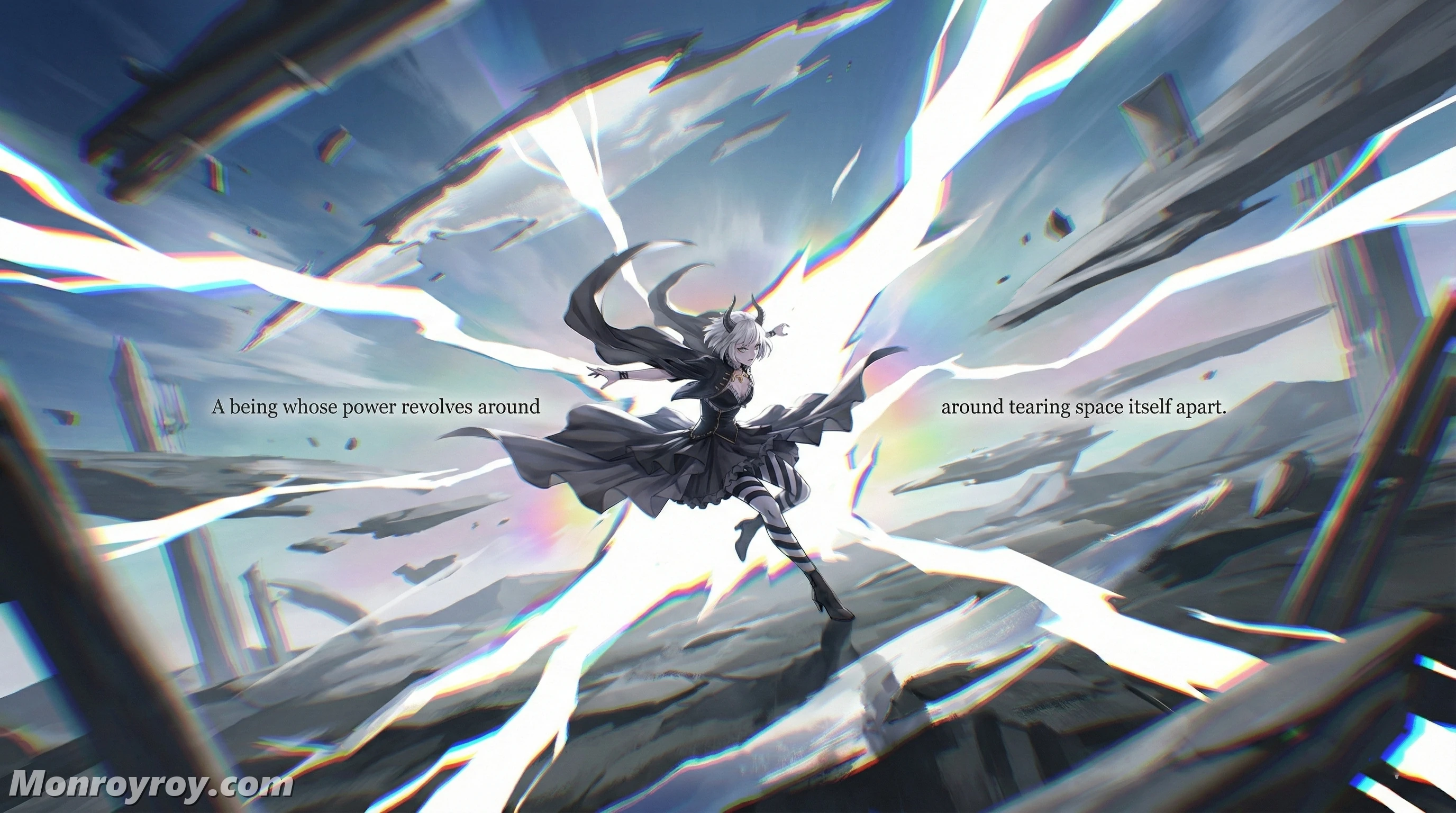
The proposed answer is a Spatial Severance–type Sage: a being whose power revolves around tearing space itself apart.
The hypothetical name is Kluft “The Divider,” taken from the German word Kluft, meaning a rift or chasm.
Hypothetical core magic: Raumriss—Dimensional Rift
Kluft does not fire energy beams. She manipulates coordinates.
Instead of destroying a wall, she removes the distance between two points: Point A outside the barrier and Point B inside it.
Why Kluft Counters Böse
Böse’s pride lies in an unbreakable shell, but a barrier remains a shell built around space.
Kluft could open a spatial rupture directly inside Böse’s body or redirect an attack through space itself, ignoring the surrounding barrier.
The barrier remains intact—perfect and untouched—but the body inside it does not.
This creates a conceptual counter: Böse relies on surface-level defense, while Kluft attacks through spatial penetration.
Sage B: Trieb “The Impulse”
Strategically, Sage B must counter Grausam, the master of illusions.
To do that, this Sage would need to be almost completely immune to mental and sensory manipulation.
At the same time, Sage B must be vulnerable to Aura. That requires a comparatively low visible mana level—low enough to lose the comparison imposed by Auserlese.
The simplest answer is a being that does not think.
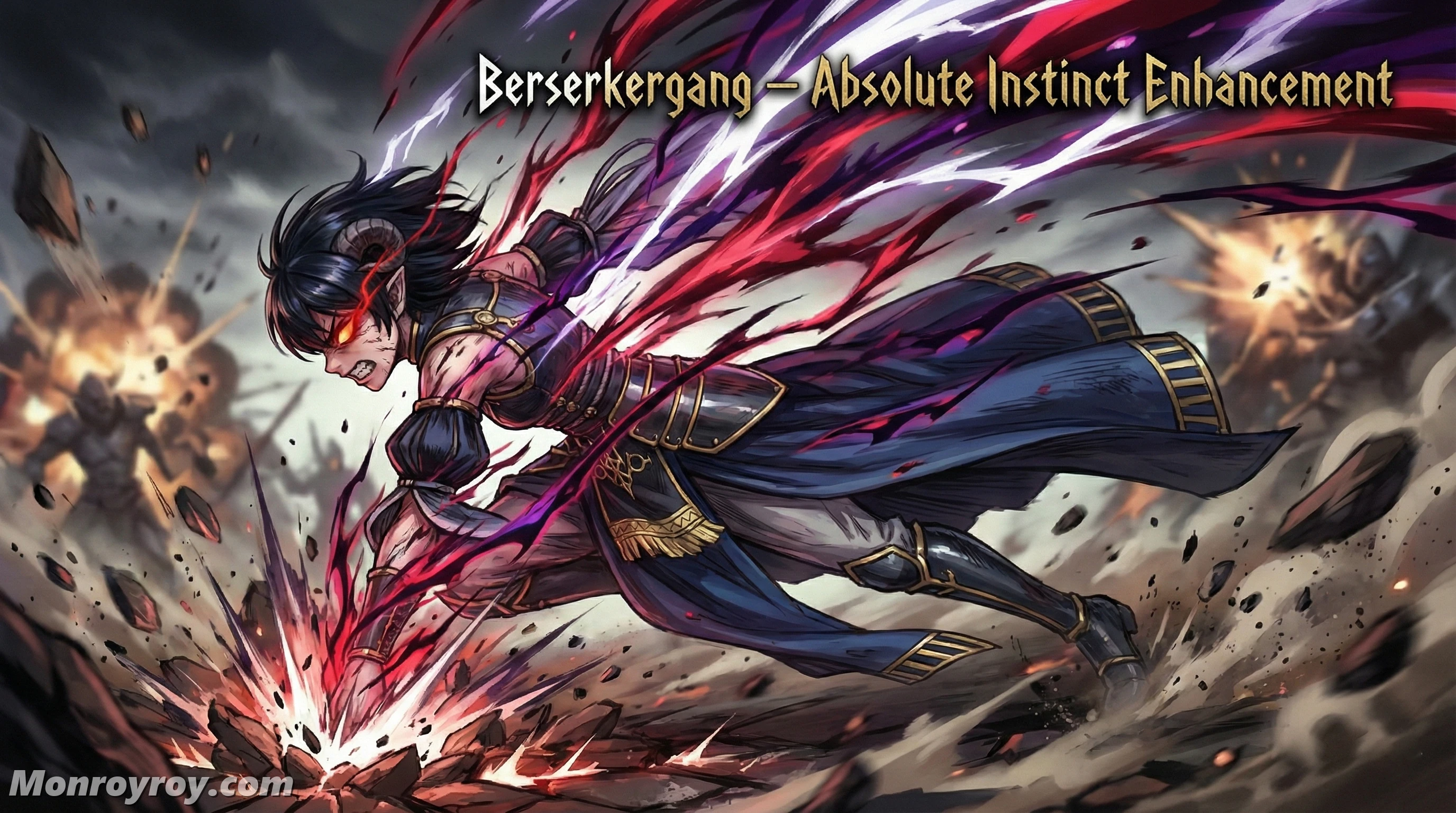
Sage B is therefore proposed as a Primal Instinct–type Sage named Trieb “The Impulse,” based on the German word Trieb, referring to instinct, impulse or biological drive.
Hypothetical core magic: Berserkergang—Absolute Instinct Enhancement
Trieb represents the absolute peak of warrior-type demons.
Unlike mage-type demons, she does not use magic for long-range attacks or complex spellcasting. She uses it for one purpose: pushing her physical body beyond all limits.
When Trieb enters Berserkergang, she shuts down higher consciousness.
No logic. No memory. No emotion.
Her body moves faster than conscious thought, reacting only to killing intent and subtle changes in the air.
At that point, she is no longer a thinking entity. She becomes a biological weapon.
Why Trieb Counters Grausam
Grausam manipulates memory, emotion and perception. But Trieb in Berserkergang does not think, remember or interpret the world through ordinary vision.
She senses the enemy’s true presence through instinct, charges directly through the illusion and attacks Grausam at close range, where he is physically weakest.
Mental magic loses its target when the opponent has deliberately discarded the mind it was meant to manipulate.
Why Aura Counters Trieb
Raw instinct carries a cost.
As a purely physical combatant, Trieb’s visible mana output would be far lower than Aura’s, much as Stark possesses far less mana than Fern.
Auserlese also does not need to alter memory, emotion or intention. It can directly override the target’s body.
Frieren’s command forcing Aura to kill herself demonstrates the distinction. Aura does not want to obey, but her body moves against her will.
Trieb cannot retreat because instinct drives her forward, and she cannot resist the scales because the mana difference is too large.
The result is brutal: the strongest close-range predator becomes the strongest puppet in Aura’s collection.
Sage C: Pest “The Plague”
The final position must counter Kluft’s precise spatial attacks while remaining vulnerable to Macht’s large-scale material transmutation.
This suggests an existence that cannot be defeated by striking a single body, yet can be neutralized when an entire environment is transformed at once.
The proposed answer is a Myriad Pestilence–type Sage named Pest “The Plague,” derived from the German word Pest, meaning plague or large-scale catastrophe.
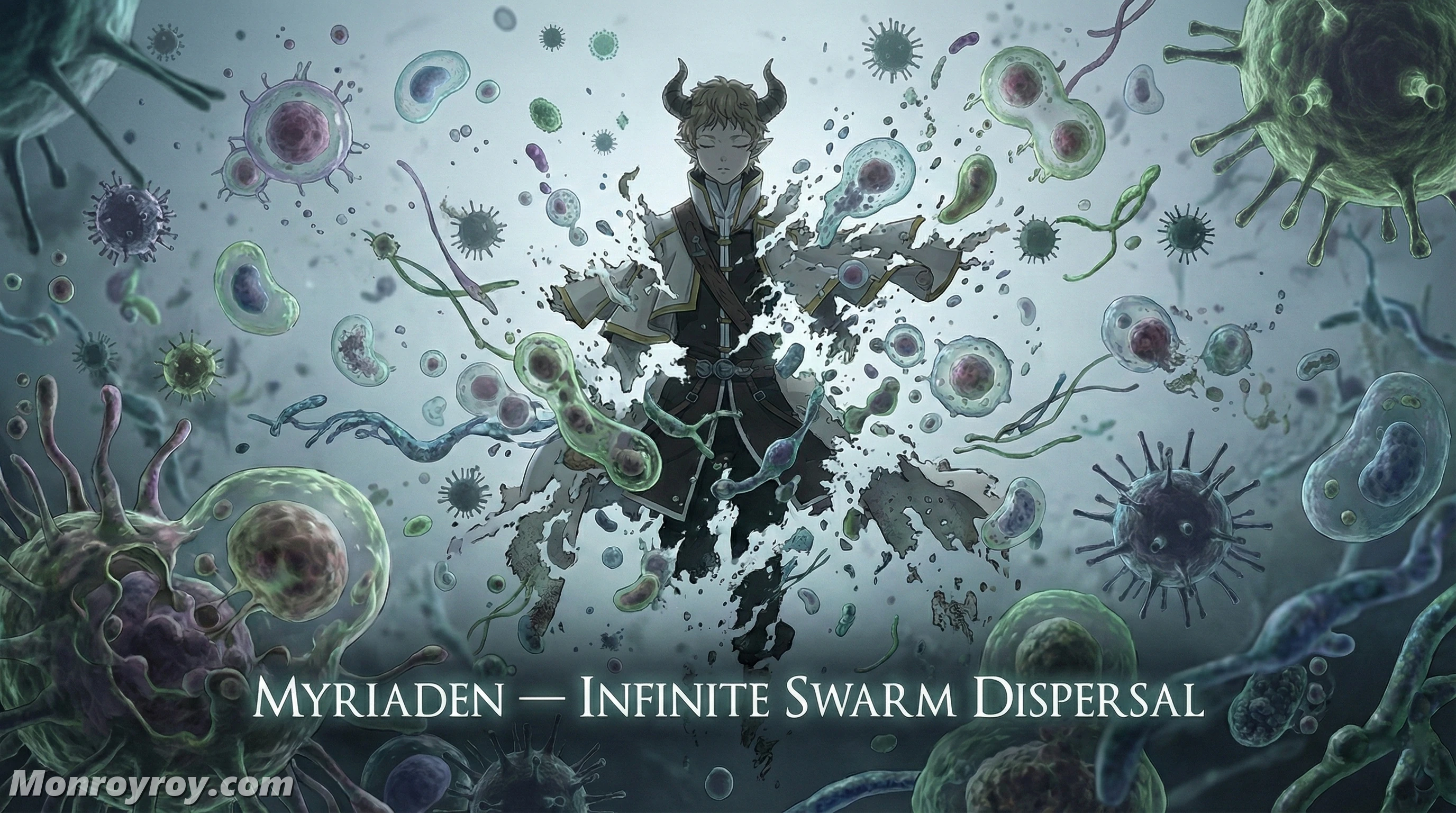
Hypothetical core magic: Myriaden—Infinite Swarm Dispersal
Pest does not possess one physical body.
He exists as a hive mind: a collective of billions of magical spores or microscopic entities acting as a single being.
His proposed abilities include corroding matter on contact, spreading with the accelerating scale of an outbreak and regenerating without limit as long as even one spore remains alive.
There is no heart to strike, no brain to destroy and no central point to target.
Why Pest Counters Kluft
Kluft can slice space itself, but cutting a swarm is like trying to stab a cloud.
Pest has no vital point for Kluft to isolate. Instead, he surrounds her from every direction, enters the body and corrodes it from within.
When there is nothing precise to hit, precision stops mattering.
Why Macht Counters Pest
Pest nevertheless has a natural predator: Macht.
Di Agölze does not rely on precision. It transforms the surrounding environment itself.
With a single thought, Macht can turn everything across an enormous radius into gold.
No matter how small Pest’s particles become, they remain matter. Every spore would be transmuted into inert gold dust and frozen permanently.
The swarm would not die in a dramatic explosion. It would become a silent statue of gold.