
The Japan manga ranking 2026 has delivered a result that few casual readers would have predicted. The Apothecary Diaries finished first, narrowly defeating Frieren: Beyond Journey’s End, while the global giant One Piece placed seventh.
The headline is surprising. The methodology behind it is even more important.
This was not a government award, a critics’ prize, or a direct sales chart. It was a large reader survey conducted by Oricon Research among people who had used electronic comic services during the previous year. Understanding that distinction changes how the ranking should be read.
Accuracy check: Oricon surveyed 10,564 readers from February 27 to March 4, 2026. Participants could choose up to three favorites from 131 titles selected from the top-selling print comics of 2025. The final order was based on a simple count of votes.
1. What the Japan Manga Ranking 2026 Actually Measures
Calling this a list of “Japan’s best manga” is convenient, but not completely precise.
Oricon’s survey began with 131 works that had already ranked highly in its 2025 print-comic sales data. The participants were people who had read manga through electronic comic apps or websites within the previous twelve months. Each person could name a maximum of three favorite titles.
That means the ranking combines several different forms of popularity:
- Recognition strong enough for a title to enter the survey pool.
- Recent engagement among digital manga readers.
- Emotional attachment strong enough for a reader to spend one of only three votes.
- The ability of a work to appeal across age and gender groups.
It does not directly measure literary quality, critical consensus, lifetime sales, or the opinions of every manga reader in Japan.
The most accurate description is this: Oricon’s 2026 list ranks the manga that surveyed digital readers were most willing to recommend or identify as favorites from a selected pool of commercially successful titles.
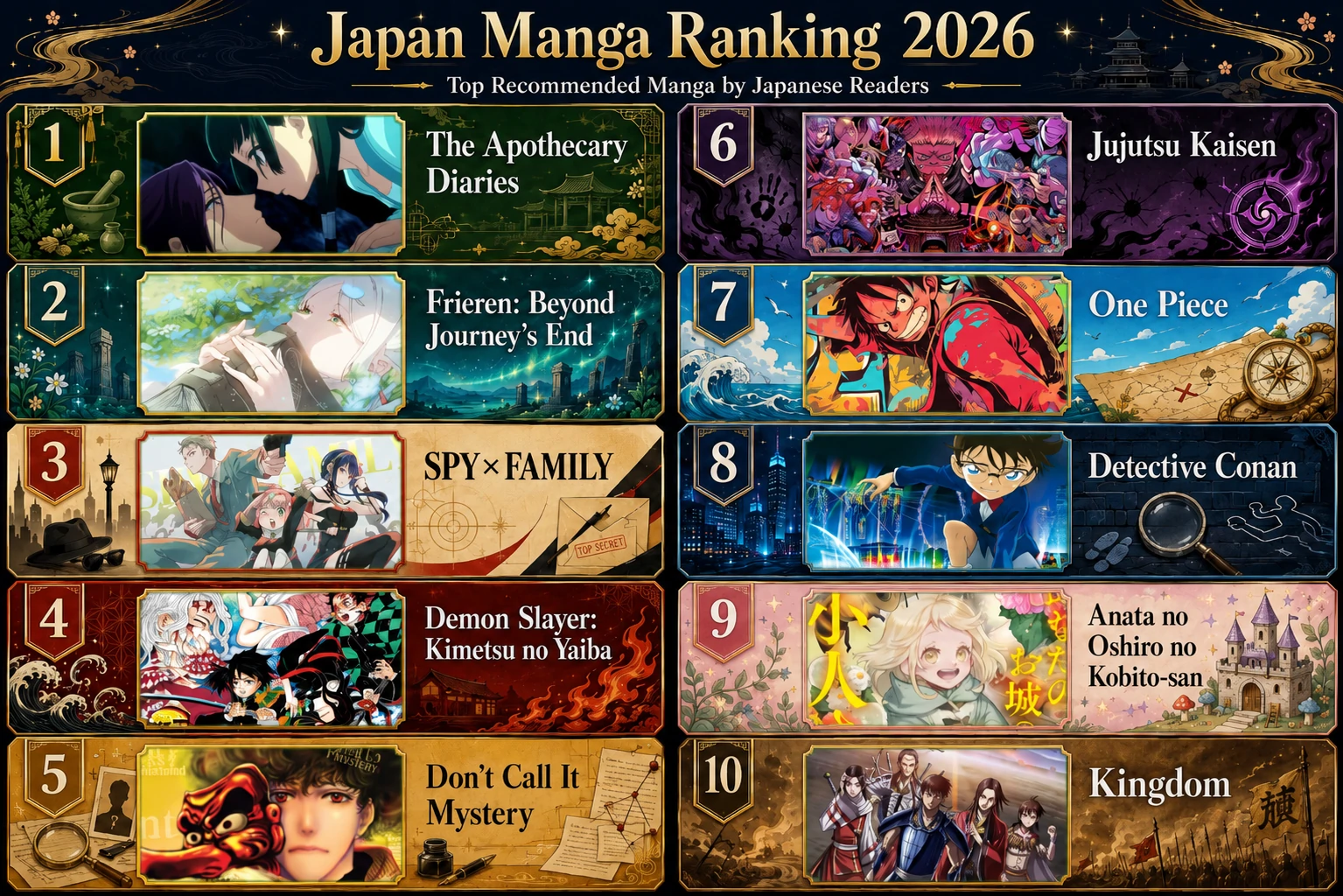
2. Top 10 Manga Recommended by Japanese Readers in 2026
The survey produced ten leading titles, with a tie for ninth place.
| Rank | Manga | Votes |
|---|---|---|
| 1 | The Apothecary Diaries (Kusuriya no Hitorigoto) | 1,200 |
| 2 | Frieren: Beyond Journey’s End | 1,118 |
| 3 | SPY×FAMILY | 831 |
| 4 | Demon Slayer: Kimetsu no Yaiba | 685 |
| 5 | Don’t Call It Mystery (Mystery to Iu Nakare) | 653 |
| 6 | Jujutsu Kaisen | 587 |
| 7 | One Piece | 557 |
| 8 | Detective Conan | 535 |
| 9 | Anata no Oshiro no Kobito-san | 514 |
| 9 | Kingdom | 514 |
The clearest result is not that action manga have disappeared. Four major battle-oriented franchises still occupy the top seven. The more interesting change is that the top three are driven by mystery, reflective fantasy, comedy, family relationships, and character chemistry rather than combat alone.
3. Why The Apothecary Diaries Finished First
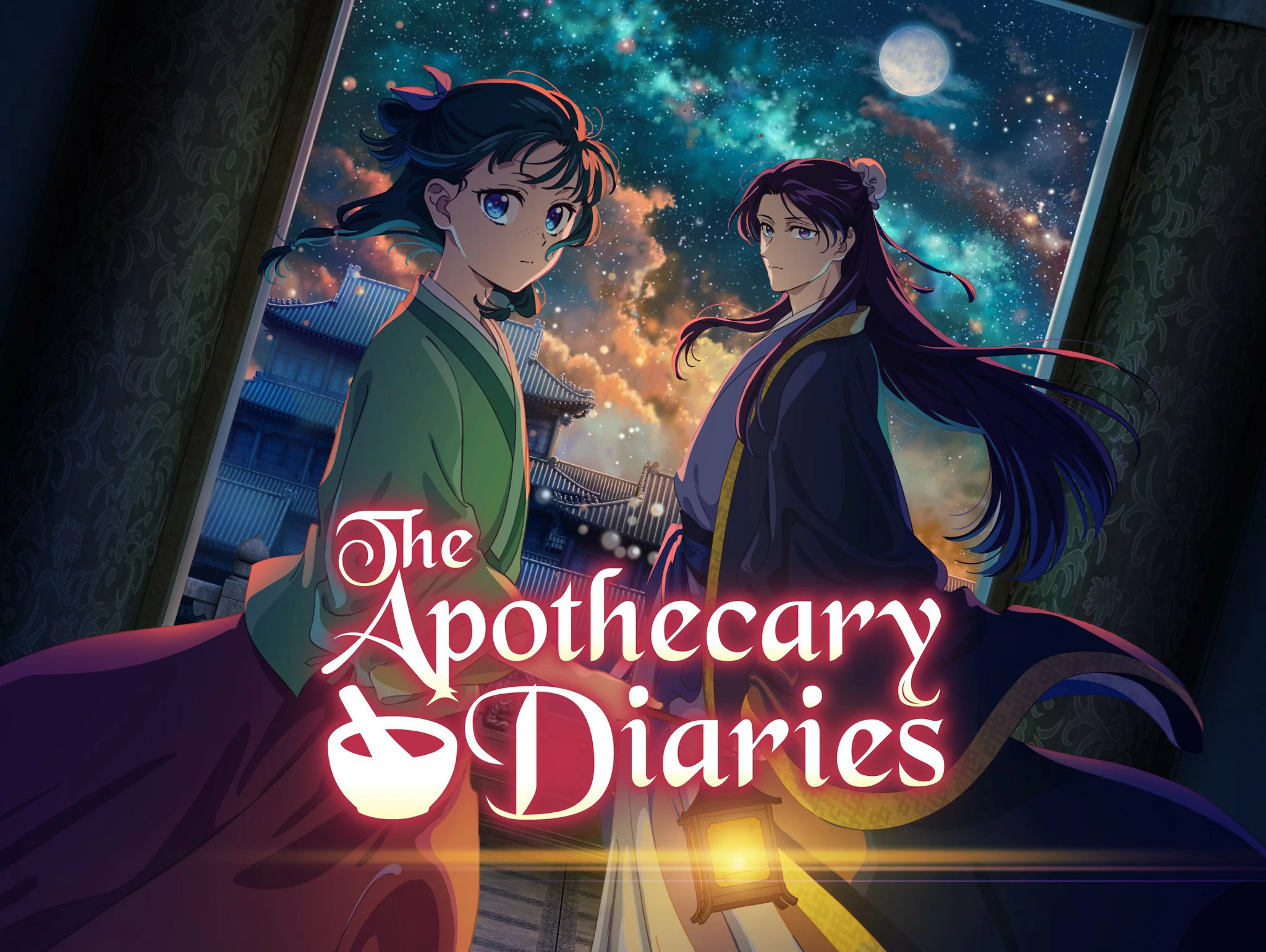
The Apothecary Diaries won with 1,200 votes, only 82 ahead of Frieren.
The series follows Maomao, a young woman trained in herbal medicine who is forced to work in the imperial palace. Her knowledge of medicine, poison, and human behavior draws her into a chain of mysteries connected to court politics and the enigmatic Jinshi.
Its appeal comes from a balance that is difficult to reproduce:
- Medical mysteries that reward close attention.
- A protagonist whose intelligence feels practical rather than decorative.
- Palace intrigue without losing emotional clarity.
- Romantic tension that develops without replacing the central mysteries.
- A story accessible to both experienced manga readers and newcomers.
The franchise also benefits from having two ongoing manga adaptations. They follow the same broad source material but differ in visual approach and in how strongly they emphasize mystery, atmosphere, or relationships.
A Strong but Uneven Demographic Profile
Oricon’s demographic data adds an important detail. Women supplied 81.9% of the title’s votes, and readers aged sixty or older represented its largest age group at 33.2%.
That does not mean the series belongs to one narrow audience. It means its winning coalition was especially strong among older women—an audience often overlooked when manga popularity is discussed primarily through shonen sales and social-media trends.
The result is less a rejection of mainstream manga than a reminder that Japan’s manga audience is broader than the loudest online fandoms suggest.
4. Why Frieren: Beyond Journey’s End Came So Close
Frieren: Beyond Journey’s End finished second with 1,118 votes.
Its premise begins where a conventional fantasy adventure usually ends. The Demon King has already been defeated. The heroes have returned home. Frieren, an elf who experiences time differently from her human companions, must confront how little she understood the people who traveled beside her.
That structure gives the manga two strengths at once. It can deliver monsters, magic, and adventure, but its emotional center is memory: what remains after victory, how people influence one another, and why seemingly ordinary moments become precious only after they are gone.
Unlike the winner, Frieren received more male than female votes, with men accounting for 60%. Its support also grew steadily across older age groups, reaching its highest share among readers aged sixty or above.
Why that matters: Frieren is not succeeding only as a current fantasy hit. Its treatment of aging, regret, companionship, and mortality gives it unusual reach among readers at very different stages of life.

5. Why One Piece at No. 7 Is Not a Collapse
The most clickable part of the ranking is One Piece placing seventh with 557 votes.
That position is surprising, but interpreting it as evidence that the series has lost its status would be a mistake.
First, this was not a sales ranking. The survey asked readers to select only three favorites from a pool containing many of the most commercially successful manga in Japan. A long-running title can remain enormously popular while losing some “recommendation votes” to newer works readers feel more urgency to name.
Second, Oricon’s own current sales module provides a useful contrast. For the week measured from July 6 to July 12, 2026, One Piece Volume 115 led the weekly comic chart with an estimated 241,644 copies sold.
The two results are not contradictory.
- The weekly chart measures purchases during a defined period.
- The recommendation survey measures which titles readers selected as personal favorites.
- A franchise can dominate sales while ranking lower in a limited-choice preference poll.
Oricon’s demographic breakdown shows that 78.6% of One Piece votes came from men. Its strongest age group was readers in their teens and twenties, followed by those in their thirties.

Bottom line: No. 7 is meaningful within this survey, but it should not be converted into a claim that One Piece is only Japan’s seventh-biggest manga overall.
6. What the 2026 Results Reveal About Manga Readers
The ranking does not prove that Japanese readers have abandoned battle manga. Demon Slayer, Jujutsu Kaisen, and One Piece remain firmly inside the top seven, while Kingdom closes the top ten.
What it does show is that the most recommended works are no longer defined by one formula.
Character Depth Can Compete With Spectacle
The first two titles are not built around constant escalation. Their strongest moments often come from observation, dialogue, memory, and the slow revelation of character.
Mystery Has Become a Major Entry Point
The Apothecary Diaries, Don’t Call It Mystery, and Detective Conan all place in the top eight. Readers are clearly willing to reward stories that make them interpret clues rather than simply wait for the next battle.
Long-Running Franchises Still Matter
One Piece, Detective Conan, and Kingdom demonstrate that longevity remains valuable. Readers continue to invest in worlds whose unresolved questions have accumulated over many years.
Anime Exposure Helps, but It Does Not Explain Everything
Every title near the top has strong cross-media visibility, yet their appeal is not interchangeable. Anime can bring readers to a manga, but the ranking suggests that sustained attachment still depends on character writing, atmosphere, and the desire to know what happens next.
7. Three Limits Readers Should Remember
The Oricon survey is large and useful, but responsible reporting should preserve its boundaries.
1. The Candidate Pool Was Preselected
The 131 eligible titles came from high-ranking print comic sales in 2025. Smaller works, digital-first manga, and critically respected titles outside that sales pool may never have appeared as voting options.
2. The Respondents Were Digital Comic Users
Participants had used an electronic comic app or website within the previous year. Their habits may differ from readers who primarily buy print manga or follow magazines directly.
3. Three Votes Create Strategic Choices
Each respondent could choose no more than three works. This format measures intensity of preference, but it cannot capture every title a reader enjoys.
The ranking is credible as a snapshot of surveyed reader preference. It should not be treated as a universal verdict on every manga published in Japan.