
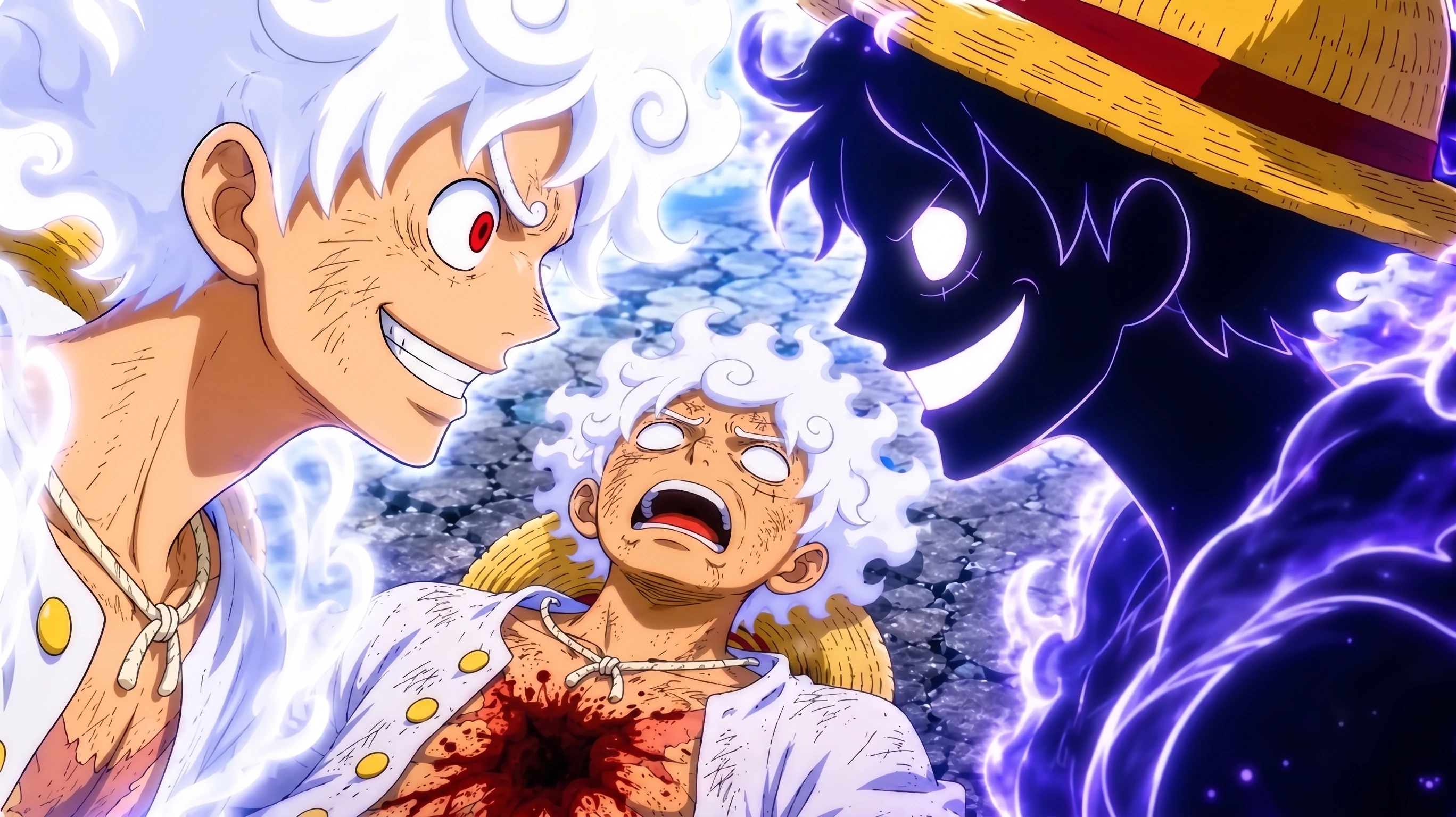
Luffy second awakening may sound impossible. A Devil Fruit is normally described as awakened or not awakened, and Gear Five already represents the awakened power of the Hito Hito no Mi, Model: Nika.
Yet One Piece Chapter 1189 places Luffy in a scene that feels too symbolic to ignore.
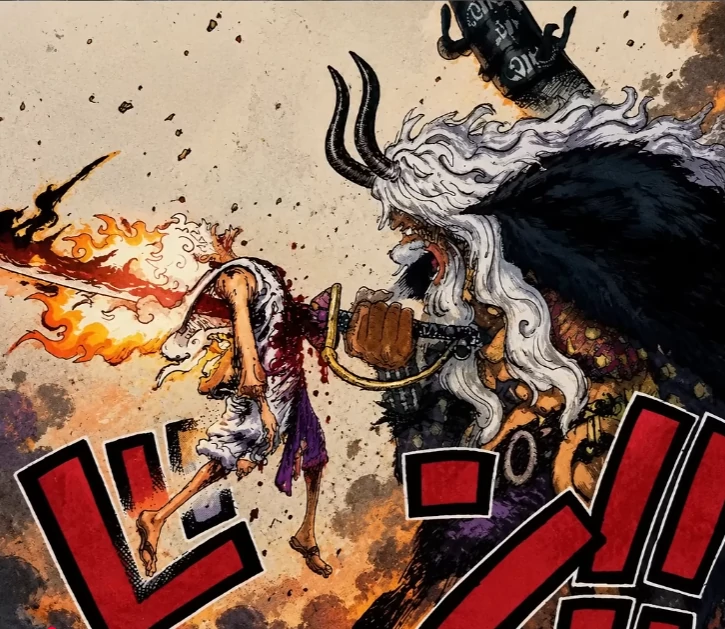
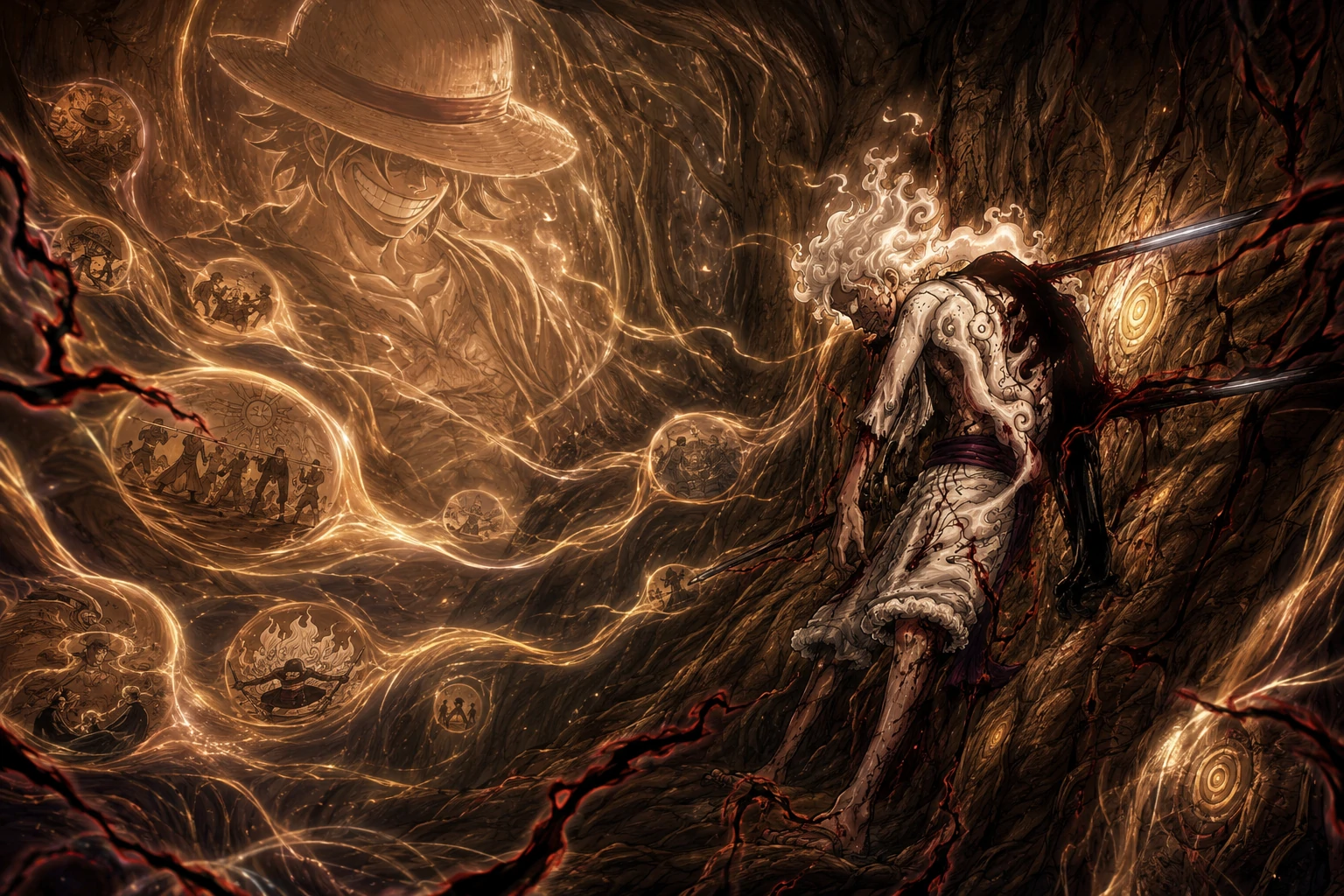
Imu drives two swords through his body and pins him against Elbaph’s colossal Jewel Tree Adam. Luffy’s presence begins to fade. Scopper Gaban arrives just in time to block the final attack, but the wounded legend cannot protect him forever.
The image strongly resembles one of the most famous episodes in Norse mythology: Odin hanging wounded from Yggdrasil, approaching death and emerging with knowledge of the runes.
If that parallel is intentional, Luffy may not simply recover. His contact with the Adam Tree could connect him to Joy Boy’s preserved will, Haki or memory—and push Gear Five into a deeper stage of mastery.
Theory note: This article preserves and develops the interpretation presented in the supplied video subtitle. The idea that Joy Boy’s spirit resides inside the Jewel Tree Adam, or that Luffy will receive a formal “second awakening,” has not been confirmed in the manga. Confirmed details and theory are separated throughout the article.
1. Luffy’s Condition After One Piece Chapter 1189
Luffy has survived impalement before, but Chapter 1189 raises the danger in several ways at once.
Imu first pierces him with the Void Sword Bahu. A second weapon, identified as the Sea God Sword, is then driven through his abdomen. Imu uses both blades to throw Luffy into the Jewel Tree Adam and hold him there.
Usopp senses that his captain’s presence is fading. Imu prepares the Xing Tian Axe for the final strike, only for Scopper Gaban to intervene with both of his axes.
This leaves Luffy in a narrow space between survival and death.
Gear Five makes his body extraordinarily difficult to destroy, but it does not remove every limit. Piercing attacks remain dangerous. The transformation consumes enormous stamina. Even after landing the Gomu Gomu no Star Gun on Kizaru at Egghead, Luffy temporarily lost the ability to continue fighting.
Imu is also unlike any opponent he has faced before. Luffy cannot rely on the same rhythm that defeated Kaido, because the ruler of the world appears to combine overwhelming Haki, unusual transformation abilities and weapons connected to ancient history.
The theory does not begin by assuming that Luffy is secretly stronger than Imu. It begins with the opposite idea: he has reached a wall that Gear Five, in its current form, cannot overcome.
2. Luffy, Odin and the Yggdrasil Parallel
Elbaph is deeply shaped by Norse imagery. Its culture, names and geography repeatedly borrow from Scandinavian mythology, while the Jewel Tree Adam visually and structurally fills the role of a world tree.
That makes Luffy’s position against the tree especially important.
In Norse tradition, Odin wounds himself with a spear and hangs from Yggdrasil for nine nights. He receives no food or drink. At the edge of death, he discovers the runes and gains a deeper form of knowledge.
Luffy does not choose his suffering. Imu forces it upon him. Even so, the visual ingredients remain remarkably similar:
- A godlike figure is wounded by bladed weapons.
- His body is suspended against a sacred world tree.
- He approaches death while blood leaves his body.
- The ordeal may lead to knowledge or power that did not exist before.
The distinction between Odin and Kozuki Oden is important. This theory concerns the Norse god Odin, not the former daimyo of Wano.
If Eiichiro Oda is using the myth as a structural reference, Luffy’s reward may not be a simple increase in strength. Odin did not merely wake up with stronger muscles. He gained access to a hidden language and a new understanding of reality.
Luffy’s equivalent could be knowledge about Nika, Joy Boy, ancient power or the true nature of his own awakening.
3. Blood, Sacrifice and Sacred Trees in One Piece
The original video connects Luffy’s bleeding body to the language of sacrifice.
One Piece has already explored sacrifice through the history of Shandia. Mousse, the daughter of Kalgara, willingly approached an altar because her people believed that offering her would save the village from a divine curse.
The important parallel is not that Luffy is repeating the exact same ritual. He is not being formally offered by his own people. Instead, his blood is being spilled against a tree whose scale and history are already treated as sacred.
Shandian beliefs also establish that trees can carry spiritual meaning. The Shandia once believed that the spirits of their ancestors followed the sound of the golden bell and lived within white trees. Their anger toward Mont Blanc Noland came partly from his decision to cut those trees down while removing the source of the disease.
That story does not prove that every ancient tree literally contains a soul. It does, however, give the series an established language for connecting trees, memory, ancestry and the dead.
When Luffy’s blood reaches the Jewel Tree Adam, the scene can therefore be read as more than physical injury. It may represent contact between the current Nika and something the ancient world left behind.
4. Could Joy Boy’s Will or Haki Remain Inside the Jewel Tree Adam?
This is the theory’s most important claim—and the point where confirmed evidence must be separated from speculation.
What the Manga Has Confirmed
Joy Boy was capable of preserving his Haki long after his death.
He tied an enormous amount of Supreme King Haki into a knot connected to Emet. When Emet released it on Egghead, the burst affected the Five Elders and protected Luffy’s escape.
This means that Haki in One Piece is not always limited to the user’s living body. Under exceptional conditions, a person’s will can be stored and released centuries later.
What the Theory Adds
The video proposes that Joy Boy may have left another fragment inside the Jewel Tree Adam.
The idea is not that a complete ghost has been confirmed inside the tree. A more cautious version is that the tree may preserve one of the following:
- A sealed concentration of Joy Boy’s Haki.
- A memory or message intended for the next user of Nika’s fruit.
- A spiritual impression that can respond to the Voice of All Things.
- A dormant mechanism from the Ancient Kingdom.
The Adam Tree is old enough, important enough and closely connected enough to Elbaph’s ancient culture to make such a hiding place narratively plausible.
Joy Boy already demonstrated the ability to prepare power for a future ally. Leaving something for the next Nika would follow the same logic as the Haki he entrusted to Emet.
The strongest supporting evidence: Joy Boy preserving Haki is canon. Joy Boy preserving Haki inside the Jewel Tree Adam is not. The theory works by extending an established ability to a new object.
5. The Voice of All Things Could Let Luffy Reach Joy Boy
Even if the tree contains Joy Boy’s will, Luffy would still need a believable way to perceive it.
The Voice of All Things provides that bridge.
This rare ability allows certain people to perceive messages from beings and objects without normal speech or writing. Luffy used it during the battle with Kaido when he fell into the sea and communicated with Kozuki Momonosuke from a great distance.
That moment established two important points.
First, Luffy can continue communicating when his physical body is almost completely helpless. Second, the Voice of All Things can carry intention across distances and conditions that ordinary speech cannot cross.
If Joy Boy left a message, memory or Haki imprint in the Adam Tree, Luffy’s near-death state could make him sensitive enough to hear it.
The encounter would not need to resemble a conventional conversation between two living people. It could appear as fragments of memory, a voice without a body, an emotional impression or a vision similar to the altered consciousness that often accompanies Luffy’s most extreme moments.
The Voice of All Things would make the meeting feel earned. Luffy would not receive a random ghostly visitor; he would use an ability the story has been developing for hundreds of chapters.
6. What a Luffy Second Awakening Could Actually Mean
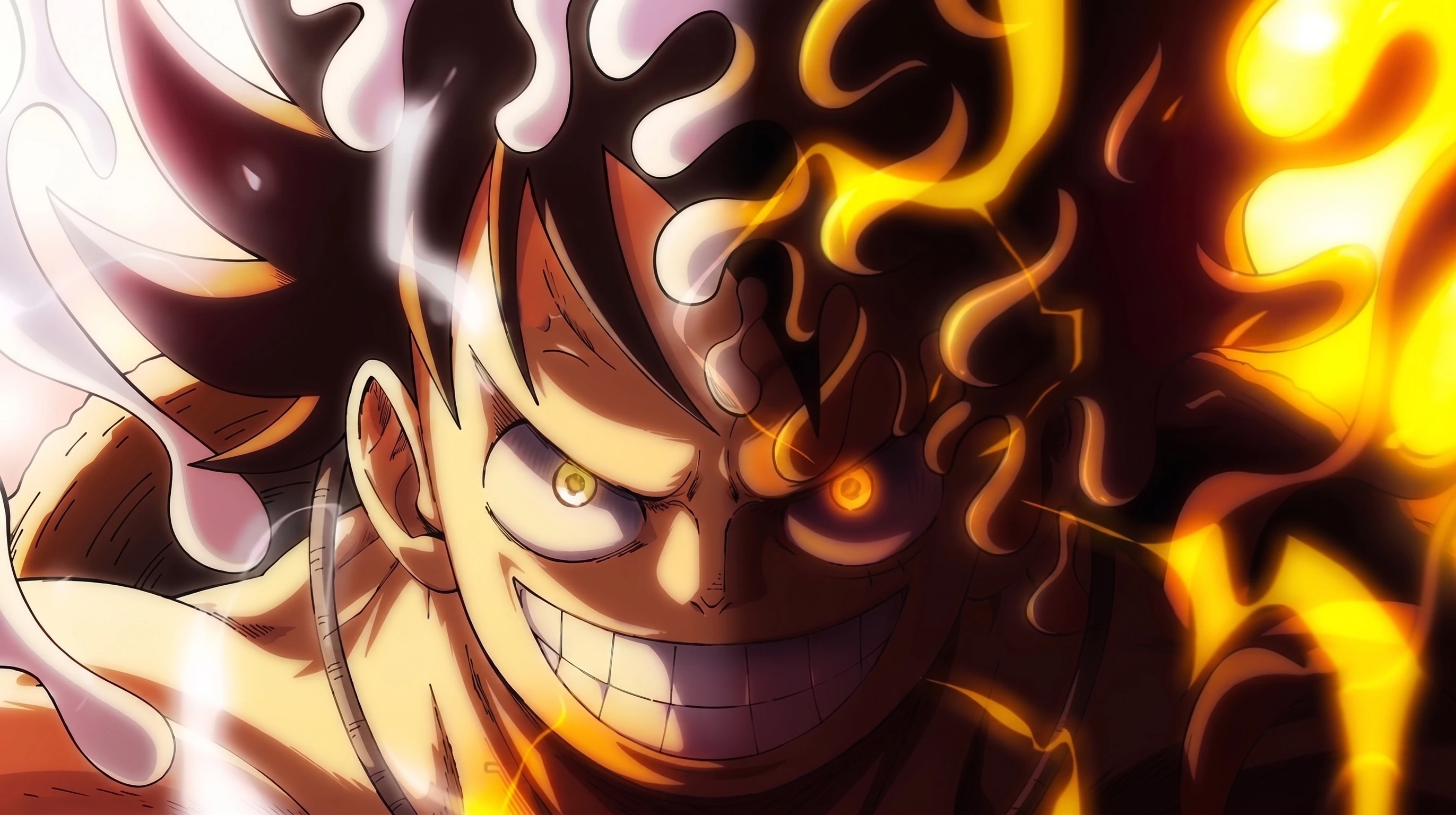
The phrase Luffy second awakening should not automatically be interpreted as a second formal Devil Fruit awakening.
Gear Five is already the awakened form of the Hito Hito no Mi, Model: Nika. The manga has not established a standard system in which an awakened fruit awakens again.
A more convincing interpretation is that Luffy will unlock a deeper level of control within the awakening he already possesses.
Greater Stamina and Stability
Gear Five remains limited by its enormous energy cost. A deeper awakening could allow Luffy to maintain the form without aging, collapsing or needing immediate food after a short burst of combat.
Understanding Nika’s Full Freedom
The Five Elders described Nika’s fighting ability as limited by imagination. Luffy currently uses that freedom instinctively, transforming the environment and his body through cartoon-like ideas.
Joy Boy may have understood principles that Luffy has not yet discovered. A message from him could teach Luffy how to use imagination without wasting power.
A New Answer to Imu’s Omen
The video predicts that Luffy may develop a power capable of opposing Imu’s Omen directly.
This does not necessarily require conventional magic. One Piece repeatedly presents Haki, Devil Fruits, inherited will and ancient technology as systems that overlap without being identical.
A new Nika technique could look supernatural while still emerging from the combination of awakened Devil Fruit power and Supreme King Haki.
Joy Boy’s Knowledge Without Losing Luffy’s Identity
The most satisfying version would not replace Luffy with Joy Boy.
Luffy’s defining quality is freedom. Allowing Joy Boy to take over his body would undermine that theme. The older figure should provide knowledge, a tool or a final clue—then leave Luffy to interpret it in his own absurd way.
A genuine second stage should make Luffy more completely himself, not turn him into a copy of the man who carried Nika’s power eight hundred years earlier.
7. Scopper Gaban Only Needs to Buy Luffy a Few More Moments
Gaban’s intervention is essential, but the theory does not require him to defeat Imu.
He reaches the battlefield while still covered in bandages and carrying injuries from earlier attacks. His body has already been pushed beyond what should be expected from an aging warrior.
Blocking the Xing Tian Axe may therefore be the final contribution he can make in the immediate battle.
Imu is unlikely to stop after one blocked attack. Luffy represents Nika, the figure whose return threatens the world order Imu has maintained for centuries. As long as Luffy remains alive, the ruler of the world has a reason to continue attacking.
Gaban’s task is not to win the war. It is to protect the silence around Luffy’s near-death experience.
Every second he holds Imu back gives Luffy more time to hear the tree, encounter Joy Boy’s preserved will or restart the Drums of Liberation.
This creates a powerful generational structure:
- Joy Boy leaves power or knowledge from the Void Century.
- Gaban, a survivor of Roger’s era, protects the transition.
- Luffy receives the chance to carry that inheritance into the final war.
8. The Weakest Parts of the Luffy Second Awakening Theory
The theory fits the imagery, but several parts remain uncertain.
The Tree May Be Symbolic Rather Than Supernatural
Luffy being pinned to the Jewel Tree Adam may only provide a dramatic location. The Yggdrasil parallel could enrich the scene without creating a literal spiritual mechanism.
Joy Boy’s Soul Has Not Been Confirmed
The manga confirms preserved Haki, not a complete surviving consciousness. Treating Haki, memory and soul as identical would go beyond the available evidence.
One Awakening May Be Enough
Oda may prefer to improve Gear Five through experience rather than introduce another named transformation. Luffy could recover, learn from defeat and fight more efficiently without receiving a second awakening.
Gaban or Another Ally Could Create the Reversal
The next turning point may belong to Gaban, Usopp, Loki or the wider Straw Hat alliance rather than to a private encounter between Luffy and Joy Boy.
These weaknesses do not make the theory meaningless. They define what future chapters would need to show:
- Luffy perceiving a voice, memory or Haki from the Adam Tree.
- A direct visual callback to Odin’s sacrifice.
- The Drums of Liberation restarting in a changed rhythm.
- A new ability that goes beyond Luffy’s current Gear Five limitations.