
Hitogami in Mushoku Tensei is dangerous for a reason that has little to do with swords, armor or spectacular attack magic.
He wins by making people believe that the decision was theirs.
When Rudeus first meets the smiling white figure in his dreams, Hitogami seems strangely helpful. He points Rudeus toward Ruijerd Superdia, offers practical guidance and repeatedly produces results. Every correct prediction makes the next instruction easier to trust.
That trust is the trap.
Behind the relaxed voice and permanent grin is the sworn enemy of Dragon God Orsted, a being who can observe possible futures, recruit apostles and push entire nations toward outcomes that protect his own existence. This is the complete story of Hitogami: his origin, appearance, relationship with Rudeus, hidden plan and the limits of the power that makes him Mushoku Tensei’s most deceptive antagonist.
Major light novel spoilers: This article discusses Future Rudeus, Roxy’s death in the ruined timeline, Rudeus’ alliance with Orsted, the Asura Kingdom conspiracy, Geese’s role and the Fighting God Armor.
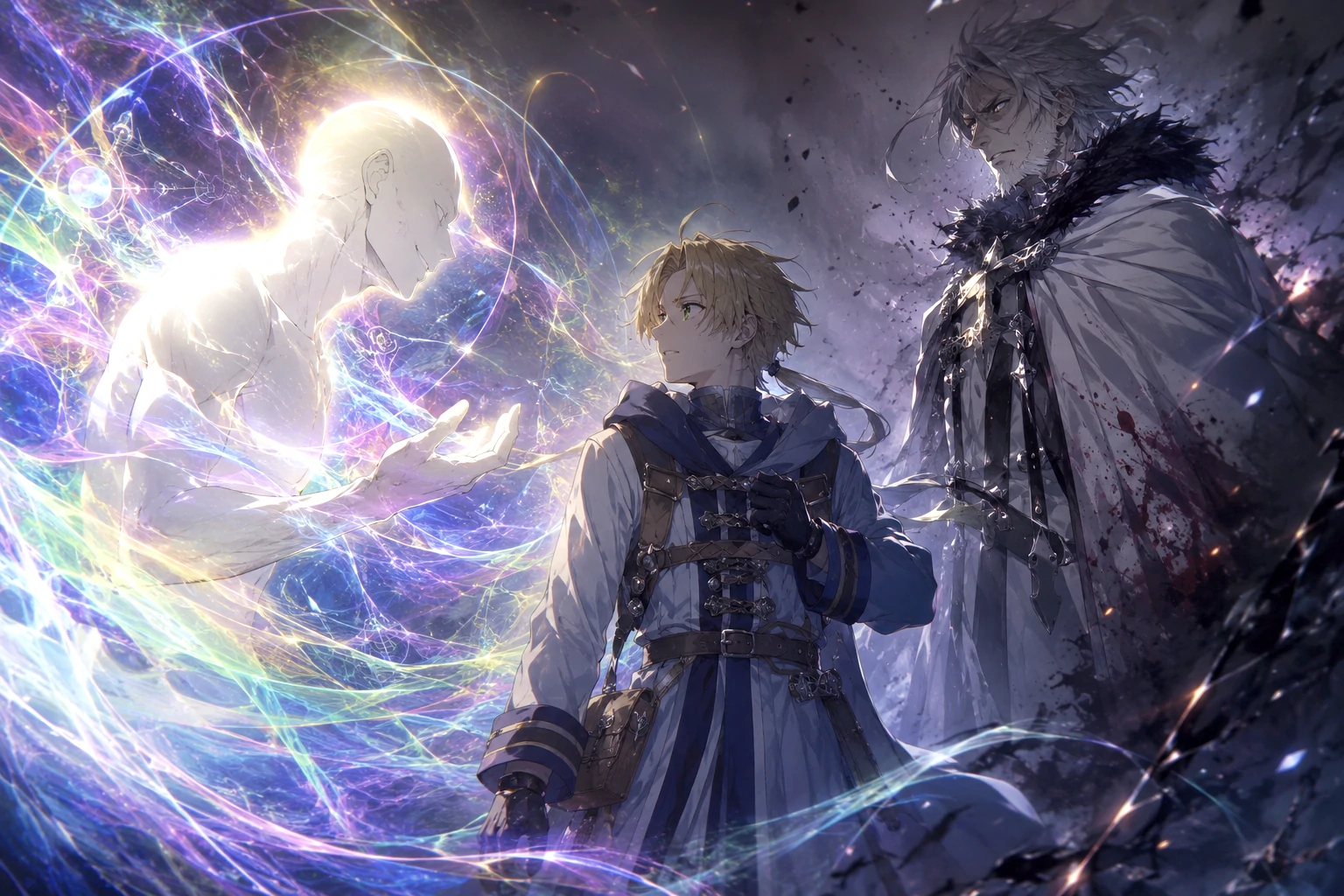
1. Who Is Hitogami in Mushoku Tensei?
Hitogami is the self-proclaimed Human God, also translated as the Man-God. He is the sworn enemy of Dragon God Orsted and eventually becomes the central force opposing Rudeus Greyrat and his descendants.
At first, Hitogami does not behave like a conventional villain. He appears in dreams, speaks casually and presents himself as a guide. He rarely demands immediate loyalty. Instead, he gives one useful instruction, waits for it to succeed and returns with another.
That method makes him feel less like a god demanding worship and more like a brilliant con artist. He does not begin by asking someone to sacrifice everything. He begins by proving that listening to him produces results.
By the time the price becomes visible, the target has already built a habit of trust.
2. The Void World and Hitogami’s Ancient Origin
The cosmology of Mushoku Tensei is built around the Six-Faced World. Its six connected realms were associated with humans, demons, dragons, beasts, the sea and the heavens.
At the center lies the Void World, an empty white realm connecting the others. This is where Hitogami resides and where he draws the consciousness of the people he contacts.
Deeper supplementary lore presents Hitogami as an unknown being born within the Void World after the Creator God’s death. He later killed or replaced the original Human God and assumed the identity now recognized as Hitogami.
His manipulation did not begin with Rudeus. In the ancient past, Hitogami turned the First Dragon God and his allies against the other worlds. The resulting wars destroyed most of the original realms. When the First Dragon God was finally weakened, Hitogami delivered the fatal blow and destroyed the Dragon World.
Before dying, however, the First Dragon God used his remaining power to seal Hitogami inside the Void World. He then prepared his son, Orsted, to continue the struggle in the distant future.
Hitogami later manipulated another historic catastrophe during the Second Great Human-Demon War. He persuaded Badigadi to steal the golden Fighting God Armor and confront Demon Dragon God Laplace. The battle ended with Laplace being split into two separate beings and left damage that permanently changed the world.
Lore distinction: Hitogami’s ancient origin and the destruction of the original worlds come from deeper novel material. The anime first presents him simply as the mysterious being who contacts Rudeus in dreams.
3. Why Hitogami’s Appearance Feels Safe and Disturbing at the Same Time
Hitogami appears as a completely white humanoid figure. He is bald, unclothed and surrounded by a soft glow. His face is difficult to describe because its details seem obscured, almost as though a mosaic covers it.
The feature people remember most clearly is his grin.
His simple form is the opposite of the elaborate costumes worn by kings, warriors and magicians. There is no visible armor, weapon or symbol of authority. Nothing on his body suggests that he is preparing to attack.
That absence of obvious danger may be part of what makes the design effective. Hitogami looks exposed and harmless, creating a false impression of openness. His radiant surroundings resemble divine imagery, while his casual manner makes the conversation feel personal rather than ceremonial.
Yet the permanent smile destroys that comfort. Because his expression barely changes, neither Rudeus nor the audience can reliably tell whether he is amused, irritated or already celebrating a disaster that has not happened yet.
Hitogami’s body communicates vulnerability, but his smile communicates control.
4. Hitogami’s First Meeting With Rudeus
In the manga adaptation, Hitogami first appears in Chapter 17, after the Teleport Incident.
The Mana Calamity has destroyed the Fittoa Region and transported Rudeus and Eris Boreas Greyrat to the Demon Continent. They awaken in one of the world’s most dangerous environments, surrounded by unfamiliar monsters, scarce food and no clear route home.
Hitogami enters Rudeus’ dream and gives one simple instruction: when Rudeus wakes, he should trust the man nearby and help him.
That man is Ruijerd Superdia.
Ruijerd belongs to the Superd race, whose reputation was destroyed by the tragedy caused by Laplace’s cursed spears. His appearance and history give Rudeus every reason to be cautious. Following Hitogami’s advice allows Rudeus and Eris to gain a powerful protector, eventually creating the adventuring party known as Dead End.
The advice is genuinely useful. That matters because Hitogami cannot manipulate Rudeus effectively if every instruction leads to obvious harm. He first needs to establish himself as a source of information that Rudeus cannot obtain elsewhere.
5. How Hitogami Turns Helpful Advice Into a Trap
Hitogami continues offering guidance as Rudeus travels across the world. Some instructions lead to allies, new abilities or solutions to immediate problems.
Each success strengthens a dangerous assumption: even when Hitogami is unpleasant, his advice is ultimately beneficial.
- He places Rudeus in locations where future events can be influenced.
- He shapes relationships whose later consequences he has already examined.
- He encourages Rudeus to judge advice by short-term benefits.
- He hides one large objective behind many unrelated choices.
Hitogami does not need every event to hurt Rudeus. He needs the overall path to prevent the future in which Orsted and Rudeus’ descendants reach the Void World and defeat him.
This is why his manipulation is difficult to detect. A lie can be exposed when it contradicts reality. Hitogami instead uses pieces of the truth, arranged so that another person walks willingly toward the result he wants.
Hitogami is patient enough to help Rudeus many times if those victories make one catastrophic request appear reasonable later.
6. Hitogami’s True Plan Against Rudeus and His Family
Hitogami can see a future in which Orsted joins forces with Rudeus’ descendants and reaches the Void World. That future ends with Hitogami’s defeat.
Because he cannot directly observe Orsted, Hitogami attacks the people and relationships that will eventually support him. One of the most important threats is the child born from Rudeus and Roxy Migurdia. Rather than confronting that future openly, Hitogami tries to prevent it from existing.
The Basement Trap and Roxy’s Death
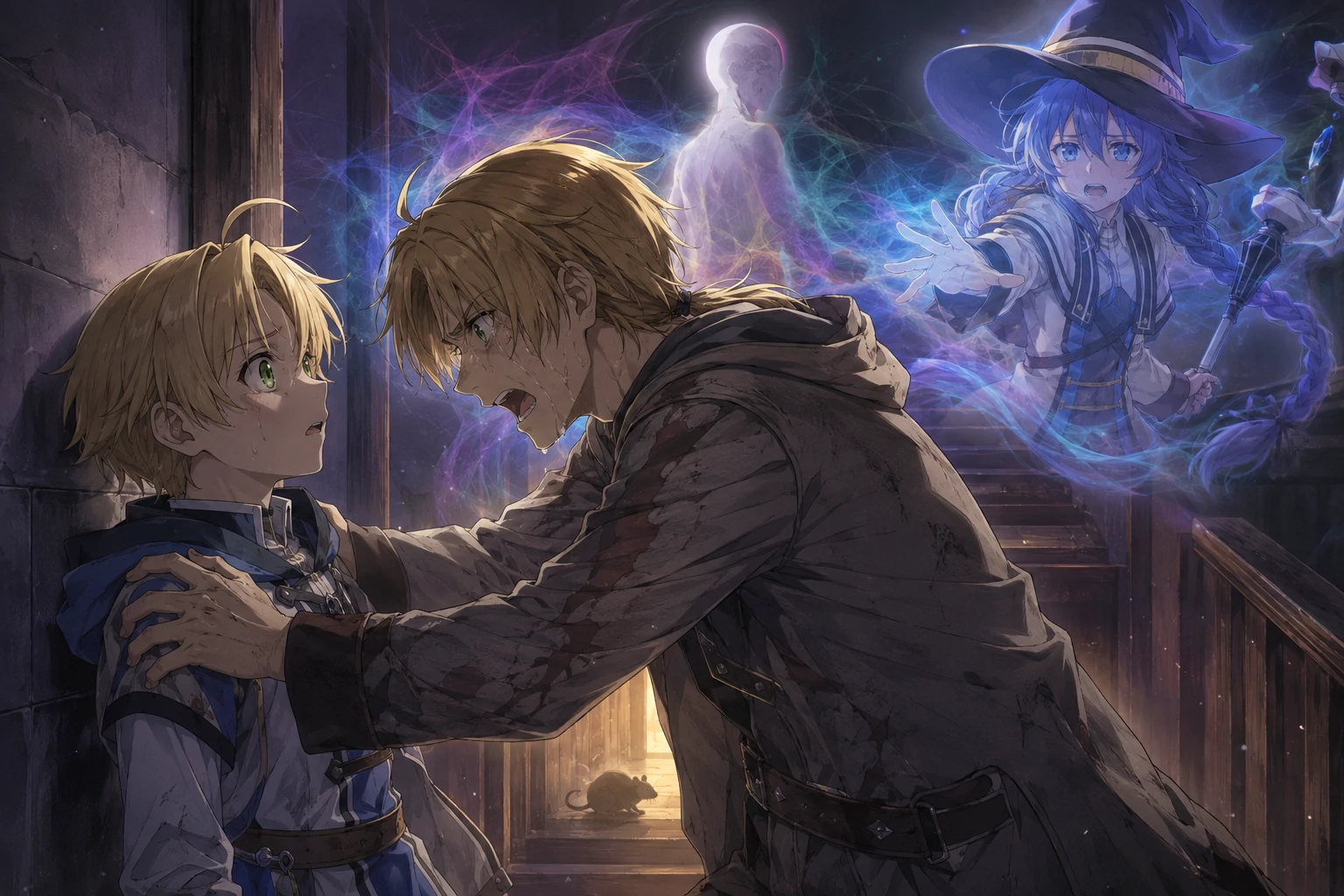
In the ruined future recorded by Future Rudeus, Hitogami directs Rudeus toward the basement. The action seems harmless, but it allows a diseased mouse to escape and begin the chain of events that kills the pregnant Roxy.
Roxy’s death destroys Rudeus emotionally. Sylphiette leaves during the collapse of their relationship and later dies. Other friends and family members are gradually lost as Rudeus becomes consumed by revenge.
The tragedy reveals Hitogami’s preferred method. He does not simply kill a target. He creates a small decision, lets cause and effect spread through ordinary life and watches the victim blame himself for the outcome.
Future Rudeus Changes the Timeline
Future Rudeus eventually discovers the truth. After years of pursuing Hitogami’s agents, he develops time-travel magic and returns to warn his younger self.
His arrival prevents the basement disaster and proves that Hitogami’s advice is not merely unreliable. It is a weapon aimed at everyone Rudeus loves.
7. Rudeus, Orsted and the War Against Hitogami
Once Hitogami realizes the basement plan has failed, he changes tactics.
He tells Rudeus that Orsted will bring destruction to the world and claims that the only way to protect his family is to kill the Dragon God. Rudeus prepares the Magic Armor and challenges one of the strongest beings alive.
The battle ends with Rudeus defeated.
Instead of killing him, Orsted listens. Rudeus explains the threat against his family and offers his service in exchange for their protection. Orsted accepts, turning the person Hitogami tried to use as a disposable weapon into his most important ally.
Orsted later gives Rudeus the Dragon God’s Armlet. The crest blocks Hitogami’s future sight from tracking the wearer and prevents him from observing Rudeus’ immediate surroundings as freely as before.
Hitogami can no longer speak to Rudeus in the same way, but the conflict does not end. It becomes a war between networks.
8. Hitogami’s Apostles and the People He Controls From the Shadows
An apostle is a person whose future Hitogami observes and influences through dreams, information and carefully selected advice.
Some apostles know they are serving him. Others believe they are pursuing their own interests. Hitogami does not require ideological loyalty when fear, ambition, revenge or affection can produce the same result.
The Asura Kingdom Conspiracy
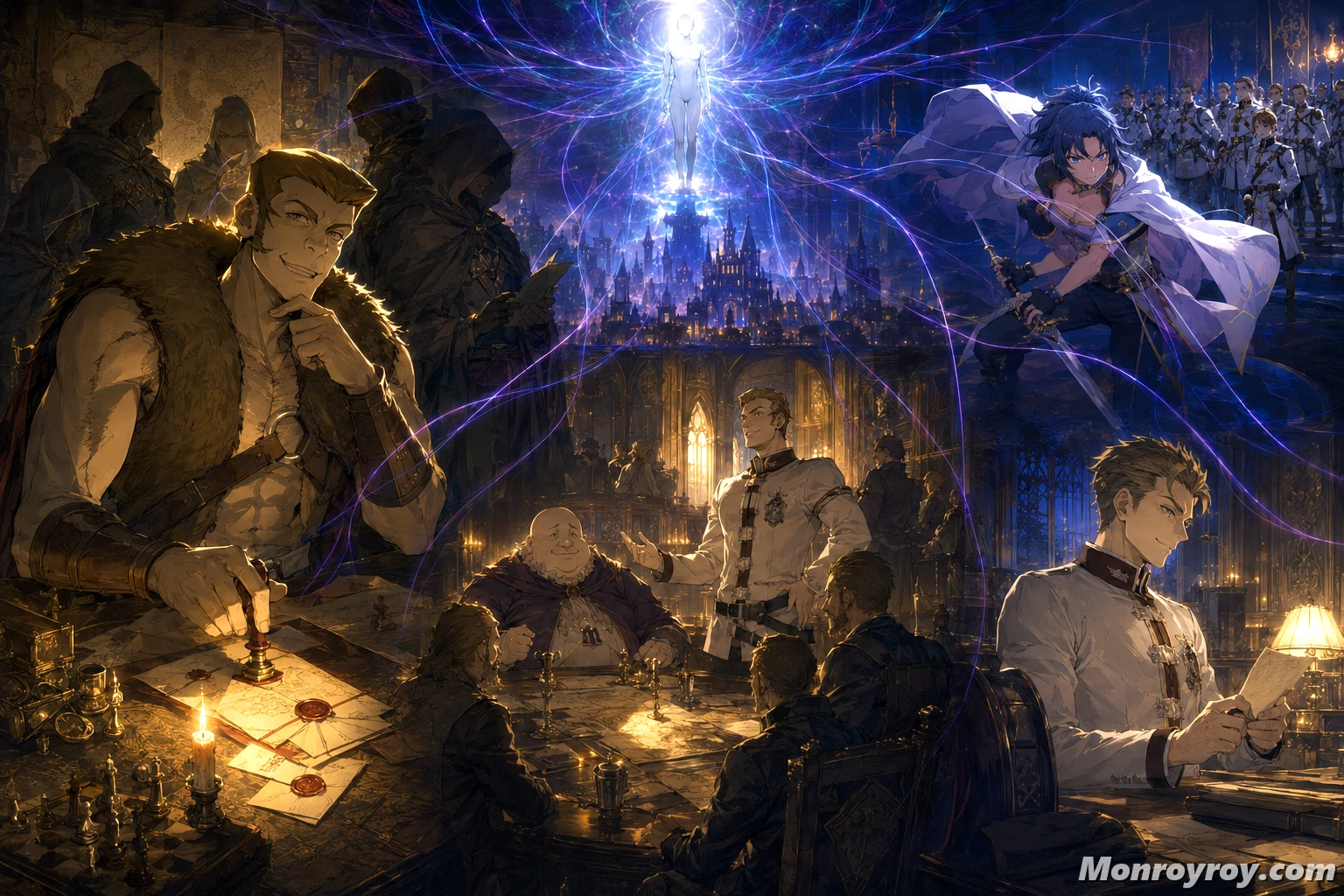
During the struggle for the Asuran throne, Hitogami manipulates influential figures including Darius Silva Ganius, Reida Reia and Luke Notos Greyrat.
Their motives are different, but their actions place obstacles in the path of Ariel Anemoi Asura and Rudeus. Hitogami uses politics as effectively as assassins because one decision inside a palace can change the future more completely than a battlefield victory.
Geese, the Apostle Hidden in Plain Sight
Geese Nukadia is one of Hitogami’s most important agents. For much of the story, he appears to be Rudeus’ ally: sociable, resourceful and useful in difficult situations.
His true loyalty allows Hitogami to operate through someone who already possesses the trust and connections needed to gather powerful enemies. Geese’s hidden role also complicates what Rudeus and Orsted believe about the number of apostles Hitogami can manage at once.
Badigadi and the Fighting God Armor
Hitogami’s connection to Badigadi reaches back to the conflict with Laplace. In the final struggle against Rudeus’ alliance, the same history becomes relevant again when the Fighting God Armor returns as one of the most dangerous weapons available to Hitogami’s faction.
9. Hitogami’s Powers and Their Hidden Limitations
Future Sight
Hitogami can observe possible futures and use that information to give advice that changes the path of events.
His power is not absolute control. Fate can be unusually strong, decisions create unexpected branches and beings outside his vision can invalidate predictions. He works by adjusting probabilities rather than issuing commands that reality must obey.
Orsted explains that Hitogami normally uses future sight on a limited number of people at the same time. Monitoring more apostles reduces the clarity and depth of his vision, especially because Hitogami continually watches his own future to protect himself.
Dream Communication and Thought Reading
Hitogami can draw a person’s consciousness into the Void World while that person sleeps. Inside the dream, he can communicate directly and understand the target’s thoughts and emotions.
This makes deception easier. He knows what the person fears, what they want to hear and which explanation will feel convincing.
The Instinctive Trust Surrounding Him
Most inhabitants of the world feel an unusual tendency to believe Hitogami. His words seem more credible than they should, even when his appearance and behavior inspire discomfort.
This influence is not universal. Rudeus and Nanahoshi come from another world and are resistant to effects that strongly shape ordinary inhabitants. Orsted also exists outside Hitogami’s observation because of protections created by the First Dragon God.
What Hitogami Cannot See
Orsted is the largest blind spot in Hitogami’s power. Hitogami cannot observe his present or future directly, so he studies the futures of people around him and infers Orsted’s actions from the changes that appear.
The Dragon God’s Armlet extends similar protection to Rudeus, denying Hitogami the information that once made manipulation so easy.
Dependence on Other People
Hitogami is sealed in the Void World. For most of the story, he acts through apostles instead of entering the Human World and solving problems personally.
This is both his greatest strength and a weakness. He can move nations without revealing himself, but every plan still depends on another person understanding the instruction, remaining loyal and surviving long enough to carry it out.
10. Is Hitogami Truly Evil, or Is He Only Trying to Survive?
Hitogami’s deepest motivation is self-preservation.
He sees a future in which Orsted and Rudeus’ descendants defeat him. From his perspective, preventing their alliance is the logical response of a being who does not want to die.
That motive creates a small amount of moral complexity, but it does not erase the methods he chooses.
Hitogami repeatedly manipulates people into destroying what they value, hides lethal consequences behind harmless instructions and treats despair as entertainment. He does not merely remove threats. He designs suffering.
The ancient wars also show that his conflict is not limited to one defensive action against Rudeus. His influence is connected to the destruction of worlds, the fall of the First Dragon God and the catastrophe that split Laplace.
Hitogami may fear death, but he protects himself by turning other lives into disposable pieces.